
Key Observations
- In March, Markets gave up much of the gains they had generated for the quarter as the Iranian conflict persisted. Stocks sold off on sentiment and rates rose based on inflation concerns.
- U.S. technology stocks, in particular software, pulled back the most as investors perceived advancements in artificial intelligence as a threat to those business models.
- The last day of the quarter ended with markets rallying after optimism that the U.S. and Iran will seek resolution, with a two-week cease fire in place. The motivation for de-escalation may be pressure on the home front with midterms looming, but the robust economic backdrop is resilient enough to absorb the shock while resolution takes shape.
Market Recap
Global stocks retreated in March after a strong start in January and February resulting in the S&P 500 ending the quarter down 4.3%, and the Nasdaq Composite down 6.9%, the worst quarter since 2022. The Iran conflict dominated sentiment from its onset on February 28th. The quarter closed on an encouraging note as the S&P 500 surged 2.9% on the last day of March (its best single trading day of 2026[1]) and potential of a resolution emerged.
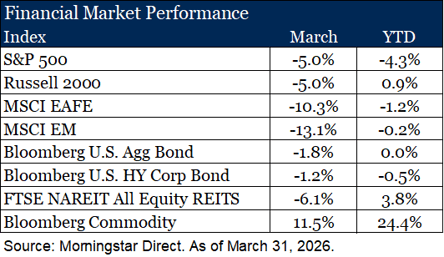
In the U.S., technology was the hardest-hit sector. Software stocks pulled back on concerns that AI investment would erode their competitive value. Over the last five years, software as a service (SaaS) traded at a 50% premium to the broader market[2]. That premium has been erased over the last two quarters. The weakness drove a broad rotation into value stocks across every market-cap tier. Large-cap growth lost 9.8%, while large-cap value gained 2.1%. Small-cap value led all segments, rising 5%, as investors sought defensively positioned, attractively priced companies.
International stocks held up well by comparison, though March returns softened as the Iran conflict came into focus. For the quarter the MSCI EAFE fell just 1.2% and MSCI Emerging Markets slipped only 0.2%, both comfortably outpacing U.S. markets.
Bond markets offered modest stability. The Bloomberg U.S. Aggregate Bond Index was flat with rates climbing through the quarter on inflation concerns tied to higher energy prices which have caused markets to have largely erased expectations for a Fed cut in 2026.
The Hormuz Problem
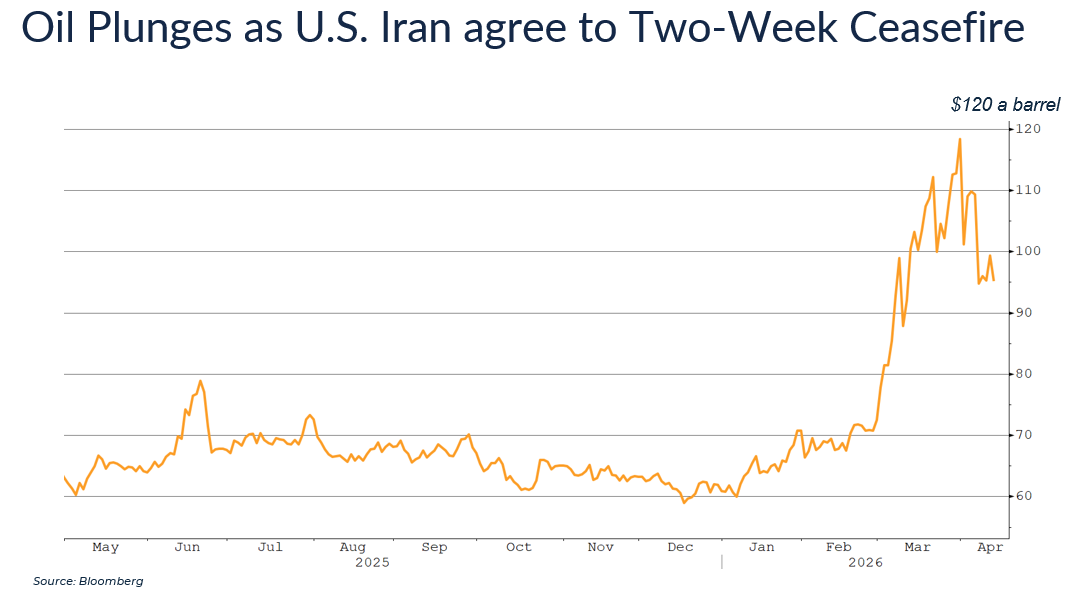
Oil not only impacts gas prices but also petrochemicals which is made from oil and natural gas. Petrochemicals provide building blocks for over 95% of all manufactured goods, including plastics, fertilizers, pharmaceuticals, and synthetic fibers. The Strait of Hormuz is the artery through which these inputs reach market. Before the conflict, roughly 21 million barrels per day moved through it, approximately 18% of global supply[3]. As a result of its closure WTI crude oil prices have risen 50% from pre-war levels and non-U.S. grades have risen by 100% or more over the first quarter. The economic toll for such disruption is acute. The Dallas Federal Reserve recently estimated if the Strait remained closed for the remainder of 2026 it would reduce real global GDP growth by 1.3%, roughly equivalent to Mexico's entire economy going dark for a year[4].
What We're Watching
Two signals will define the long-term impact of this conflict.
The first is whether Iran tests its leverage over the Strait of Hormuz. Before this conflict, the idea of an Iranian toll on commercial vessels was not a serious risk scenario. It is now. Nearly 140 ships transit the Strait each day. Iran has floated a $2 million levy per vessel. If implemented, that generates over $100 billion in annual revenue, nearly double its current oil export income of $53 billion[5]. The financial incentive is real. A permanent toll regime would create lasting friction for Western markets.
The second signal is the extent of damage to energy infrastructure. A swift resolution could reopen the Strait within weeks. But physical damage to production and refining facilities is a different problem. Repairs take months, sometimes years. If supply contracts structurally with no credible alternative to fill the gap, the inflationary pressure this conflict has already created may not be resolved when the fighting ends.
Where do we go from here?
The U.S. midterm elections are nearing with gasoline and inflation at the forefront of campaigns with higher prices felt at every fill-up. The challenge remains finding a credible exit. With news about passage on the Strait changing daily, finding a resolution to tame price shocks will be very important ahead of the midterms.
Additionally, we see genuine reasons for measured optimism. Earnings growth is broadening, and shelter costs continue to moderate. Critically, a soft labor market reduces pressure on the Fed to respond to high inflation driven by energy prices. Collectively, these conditions buy time for a diplomatic resolution and create the backdrop under which one can succeed.
In Conclusion
As a result, we are maintaining current positioning and watching evolving conditions closely. Risks remain, chiefly around infrastructure damage and Iran's willingness to negotiate in good faith, we are watching both closely. We maintain our focus on high-quality investments with downside protection. Please do not hesitate to reach out to your advisors with any questions or concerns.
Sources
[1] Bloomberg as of April 1, 2026
[2] FactSet as of April 1, 2026
[3] JPMorgan as of April 6, 2026
[4] Federal Reserve Bank of Dallas, as of March 20, 2026
[5] Energy Information Administration (EIA), August 2025
Disclosures
The information provided is illustrative and for educational and informational purposes only and does not constitute investment advice and it should not be relied on as such. It should not be considered a solicitation to buy or an offer to sell a security. It does not take into account any investor's particular investment objectives, strategies, tax status or investment horizon. You should consult your attorney or tax advisor.
The views expressed in this commentary are subject to change based on market and other conditions. This document may contain certain statements that may be deemed forward looking statements. Please note that any such statements are not guarantees of any future performance and actual results or developments may differ materially from those projected. Any projections, market outlooks, or estimates are based upon certain assumptions and should not be construed as indicative of actual events that will occur. Certain targets within the presentation are estimates based on certain assumptions and analysis made by the advisor. There is no guarantee that the estimates will be achieved.
All information has been obtained from sources believed to be reliable, but its accuracy is not guaranteed. There is no representation or warranty as to the current accuracy, reliability or completeness of, nor liability for, decisions based on such information and it should not be relied on as such.
No investment strategy or risk management technique can guarantee returns or eliminate risk in any market environment. All investments include a risk of loss that clients should be prepared to bear. The principal risks of Clarendon Private’s strategies are disclosed in the publicly available Form ADV Part 2A.
Diversification does not ensure a profit or guarantee against loss. Asset Allocation may be used in an effort to manage risk and enhance returns. It does not, however, guarantee a profit or protect against loss. Index returns are unmanaged and do not reflect the deduction of any fees or expenses.
Comparisons to any indices referenced herein are for illustrative purposes only and are not meant to imply that actual returns or volatility will be similar to the indices. Index returns reflect all items of income, gain and loss and the reinvestment of dividends and other income. You cannot invest directly in an Index.
• S&P 500 is a capitalization-weighted index designed to measure performance of the broad domestic economy through changes in the aggregate market value of 500 stocks representing all major industries.
• Russell 2000 consists of the 2,000 smallest U.S. companies in the Russell 3000 index.
• MSCI EAFE is an equity index which captures large and mid-cap representation across Developed Markets countries around the world, excluding the U.S. and Canada. The index covers approximately 85% of the free float-adjusted market capitalization in each country.
• MSCI Emerging Markets captures large and mid-cap representation across Emerging Markets countries. The index covers approximately 85% of the free-float adjusted market capitalization in each country.
• Bloomberg U.S. Aggregate Index covers the U.S. investment grade fixed rate bond market, with index components for government and corporate securities, mortgage pass-through securities, and asset-backed securities.
• Bloomberg U.S. Corporate High Yield Index covers the universe of fixed rate, non-investment grade debt. Eurobonds and debt issues from countries designated as emerging markets (sovereign rating of Baa1/BBB+/BBB+ and below using the middle of Moody’s, S&P, and Fitch) are excluded, but Canadian and global bonds (SEC registered) of issuers in non-EMG countries are included.
• FTSE NAREIT Equity REITs Index contains all Equity REITs not designed as Timber REITs or Infrastructure REITs.
• Bloomberg Commodity Index is calculated on an excess return basis and reflects commodity futures price movements. The index rebalances annually weighted 2/3 by trading volume and 1/3 by world production and weight-caps are applied at the commodity, sector and group level for diversification.
Clarendon Private, LLC (“Clarendon Private”) is a registered investment advisor. Advisory services are only offered to clients or prospective clients where Clarendon Private and its representatives are properly licensed or exempt from licensure. For additional information, please visit our website at https://www.clarendonprivate.com or the Investment Adviser Public Disclosure website at www.adviserinfo.sec.gov by searching with Clarendon’s CRD # 316616